
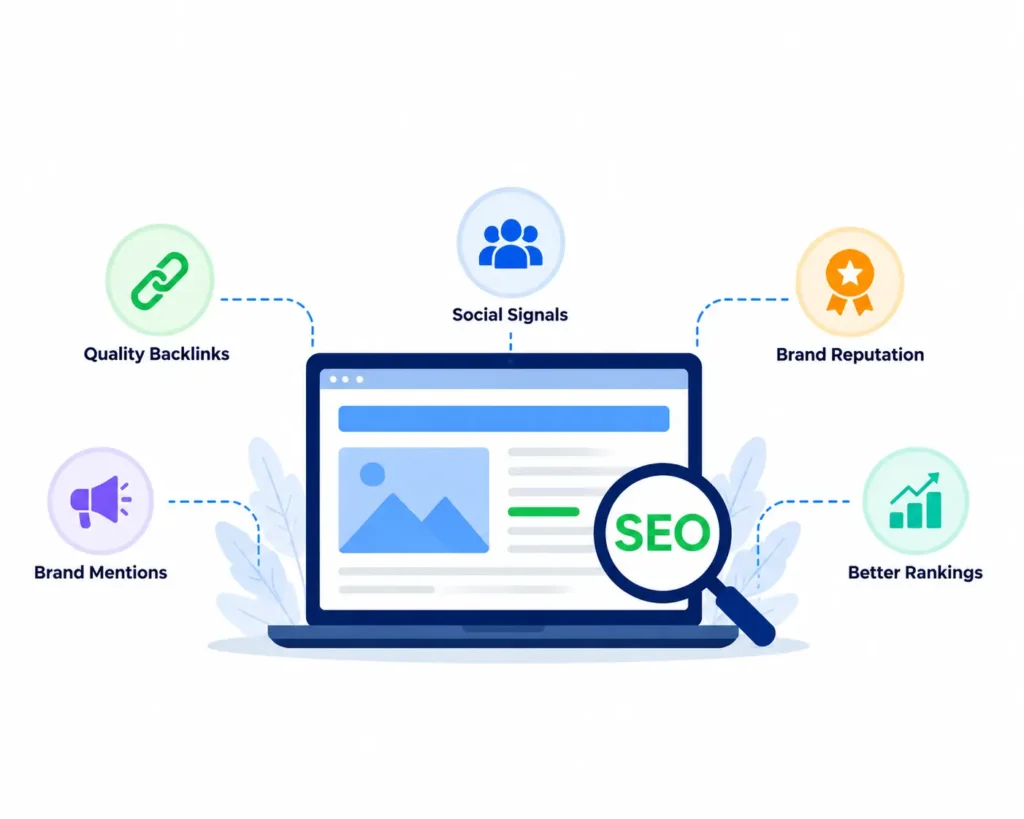
Off-page SEO refers to all the actions taken outside of your own website to improve your search engine rankings and increase your website’s authority. While on-page SEO focuses on optimizing content, titles, headings, images, and technical elements on your website, off-page SEO focuses on building credibility and trust through external signals, the most common of which are backlinks.
Backlinks, also known as inbound links, are links from other websites pointing to your website. Google and other search engines consider backlinks as votes of confidence. The more high-quality and authoritative backlinks your site has, the more likely it is to rank higher in search results.
Need help building high-quality backlinks and improving your website authority? Check out my professional services: Expert SEO, WordPress Design & Website Speed Optimization to get on-page and off-page SEO, link building, and website management tailored for your business.
Off-page SEO is essential because even if your website is perfectly optimized on-page, without quality backlinks and external signals, it may struggle to rank. Off-page SEO not only improves search engine rankings but also helps your website gain visibility, attract organic traffic, and establish trust with users and other websites.
Importance of Off-Page SEO
- Improves Domain Authority: Websites with strong off-page SEO tend to have higher domain authority, making it easier to rank for competitive keywords.
- Boosts Organic Traffic: High-quality backlinks drive referral traffic from authoritative websites.
- Enhances Brand Reputation: Being linked by credible websites signals trustworthiness to both users and search engines.
- Faster Indexing: Search engines discover new content faster when it’s linked from other active sites.
- Competitive Advantage: Sites with better off-page SEO often outrank competitors with similar content but weaker backlink profiles.
What Is Link Building?
Link building is the process of acquiring backlinks from other websites to your own. This is the most important component of off-page SEO because search engines use backlinks to determine the relevance, authority, and trustworthiness of a website.
Backlinks can be classified into two main types:
Do-Follow Links
Do-follow links are standard links that allow search engines to follow them and pass link equity (SEO value) from the linking site to the linked site. These links help improve your site’s authority, credibility, and ranking potential.
No-Follow Links
No-follow links include a special HTML attribute (rel="nofollow") which tells search engines not to pass link equity. While they don’t directly improve rankings, no-follow links are still valuable for generating traffic, building brand awareness, and creating a natural backlink profile.
Key Components of Link Building
Anchor Text Distribution
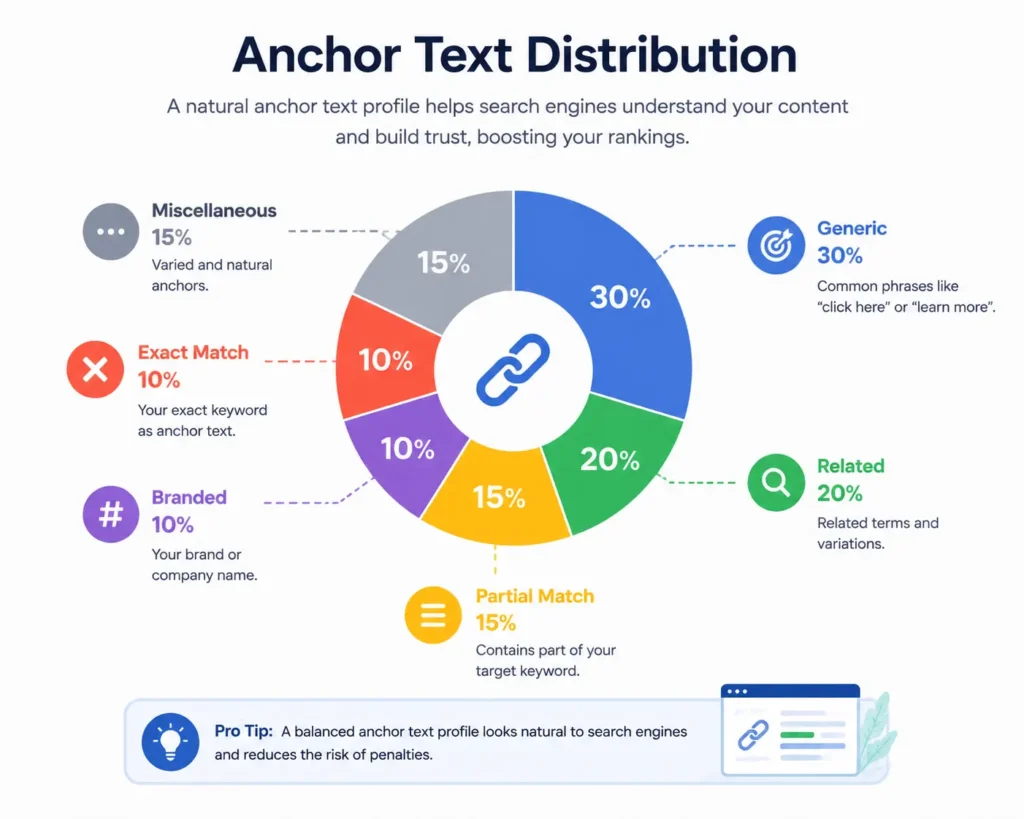
Anchor text is the visible, clickable text in a hyperlink. Proper anchor text distribution ensures backlinks look natural to search engines. Common anchor types include:
- Brand Name: The website’s brand name is used as anchor text.
- Branded Anchor Text: Combination of brand and keyword.
- Exact Match Keywords: The exact target keyword; use sparingly to avoid penalties.
- Partial Match / Phrase: A phrase containing a target keyword.
- Generic / Random: Text like “click here” or “learn more.”
- Naked URL: Direct URL as the anchor text.
Traditional Link Building Techniques
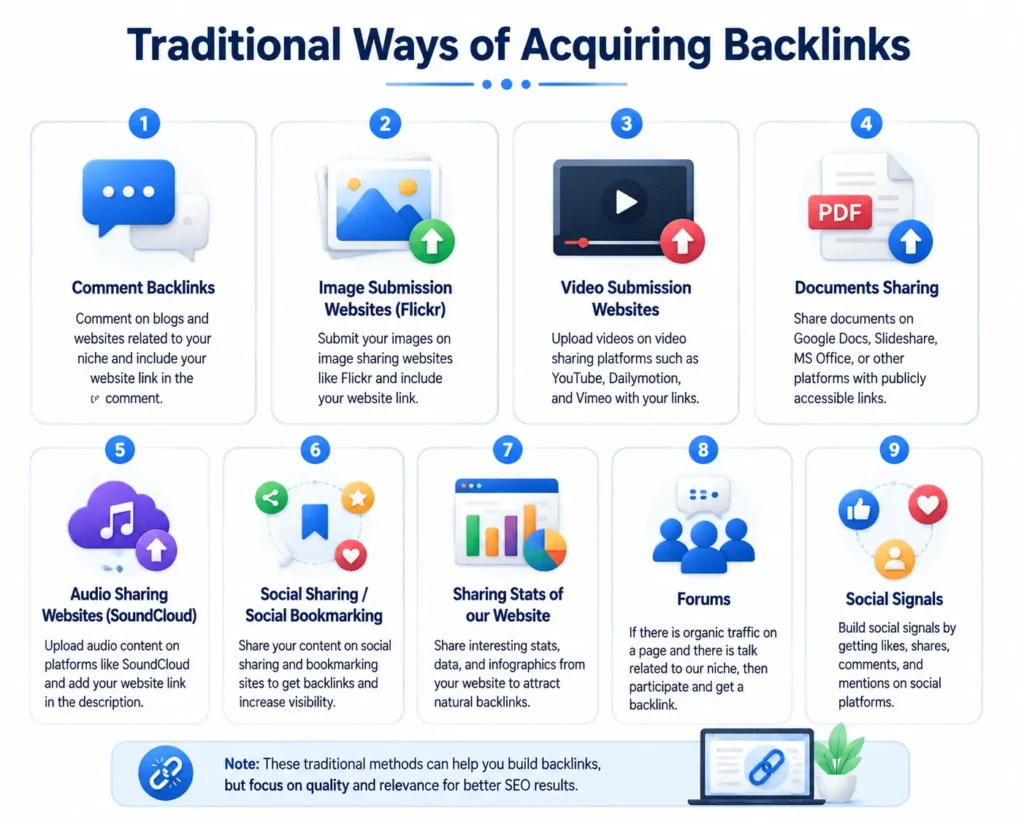
- Comment Backlinks: Posting meaningful comments on relevant blogs with links.
- Image Submission: Uploading images to platforms like Flickr or Pinterest with backlinks.
- Video Submissions: Sharing video content on YouTube, Dailymotion, or Vimeo with links.
- Document Sharing: Sharing PDFs, slides, or presentations on platforms like Slideshare or Google Docs.
- Forum Participation: Engaging in niche forums and including backlinks where appropriate.
- Social Bookmarking: Submitting content to sites like Reddit, StumbleUpon, or Digg.
These methods help in gaining initial backlinks but require consistent effort and careful selection of quality sources.
Advanced Link Building Techniques
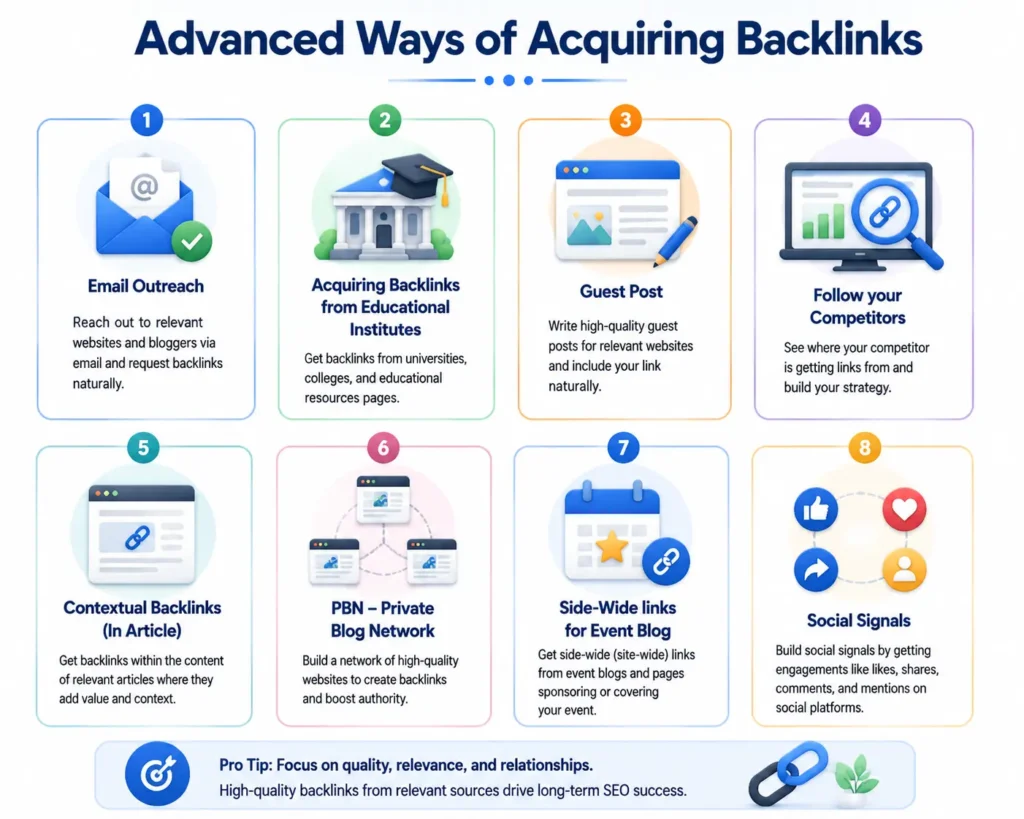
- Competitor Reverse Engineering: Analyze competitors’ backlinks using tools like Ahrefs or SEMrush, and replicate high-quality links.
- Outreach Campaigns: Contact website owners directly, offer guest posts, or request backlinks from authoritative sources.
- PBN (Private Blog Networks): Using a network of websites to create backlinks to your site. (We will cover PBNs in detail in a separate article.)
- Contextual Backlinks: Place links naturally within relevant content rather than in the footer or sidebar.
- Email Outreach: Personalized emails to site owners for backlink opportunities.
- Educational and Authority Links: Acquiring links from .edu or high-authority sites to boost credibility.
Best Practices for Off-Page SEO
- Focus on quality over quantity. A few authoritative backlinks are better than hundreds of low-quality links.
- Diversify anchor text naturally to avoid penalties.
- Monitor backlink profile regularly using tools like Ahrefs, SEMrush, or Moz.
- Avoid spammy link-building practices such as paid link farms or excessive link exchanges.
- Aim for a natural link profile with a mix of do-follow and no-follow links.
Conclusion
Off-page SEO is a crucial part of your digital marketing strategy. While on-page SEO ensures your website is optimized for users and search engines, off-page SEO builds credibility, authority, and trust through backlinks and external signals. By following ethical link-building practices, maintaining a natural distribution of anchor text, and combining traditional and advanced strategies, your website can achieve higher rankings, more organic traffic, and long-term success in search engines.